keep safe

5 graded exercises, 15 minutes a day for 4 weeks 

Children with movement difficulties, especially those with joint hypermobility (low muscle tone) often complain of muscle or joint pain in the legs, either after exercise or at night when there is no apparent injury or swelling. The most common cause for the pain is muscle tightness and weakness.

How hard can I push my child?

As a parent-coach you need to carefully gage how much to push your child to work a little harder.  If you start slowly, keep the load relatively light and make time for daily training sessions you will quickly get an idea of how much your child can do without provoking pain after exercise and pain at night. A little bit is OK - a lot is not a good idea. You may need to retreat a little and build up more slowly. 

But do not give up. Do not be disheartened too quickly. 

Important: Before your start: 

Please consult your child's health care provider before starting on an exercise program.

If your child experiences a flare up of joint pain with swelling and skin warmth (a sign of inflammation) take a break until the acute inflammation dies down. Consult your doctor or physical therapist for advise on how to proceed. 

For subscribers A training program for children experiencing leg pain

A set of 5 graded exercises with instructions for increasing load over a period of 4 weeks.

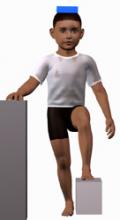
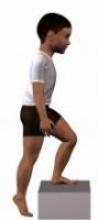
step-up-2.jpgStepping up and down on a step (steps ups)


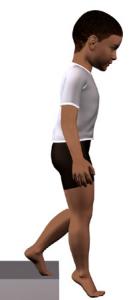
step down 1.jpgStepping down from a step 

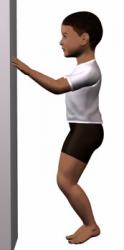
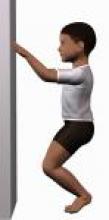
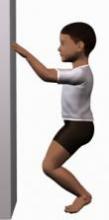
bend-knees.jpgHalf squats for knee strength

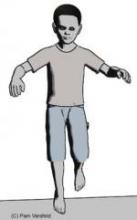
Stand one leg support foot  on box_0.jpgStanding on one leg: for balance and hip muscle strength

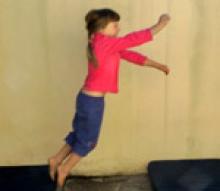
standing broad jump 1.jpgJumping between cushions 

For strength, power, coordination and stamina 

More ideas for training leg muscle strength, coordination and agility

Disclaimer

The content on this site is provided for general information purposes only and does not constitute professional advice. Please consult your child's health care provider before embarking on an exercise program. 


SfA Fitness and Coordination Training Guide 
All the information you need to be your child's coach and advocate 

$20 for a 12 month subscription     

Subscribe here 

Read more about 
Low Muscle Tone Handbook (PDF downloads) 
Training coordination for everyday activities 
Training strength and flexibility - exercise instructions 


Disclaimer  The content on this site is provided for general information purposes only and does not constitute professional advice. All liability is excluded to the fullest extent permitted by law in respect of any loss or damage whether direct, indirect or consequential that arises in connection with the use of or reliance upon any content forming part of this site.
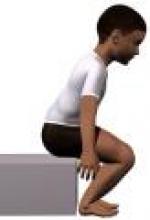
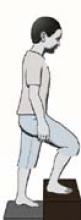
Standing up from a low step strengthens the hip and knee muscles. The height of the step is adjusted to make the exercise more difficult as the child gets stronger. 

Step ups are a good way to strengthen the leg extensor muscles for stair climbing and walking up a hill.  Done fast they also challenge balance and improve general fitness. 

training-stepping-down

Training program (with 4 levels of difficulty )for stepping down and going down a flight of steps.  

File download: 

PDF files : 

The purpose of this exercise is to develop strength in the knee extensor and calf muscles starting slowly and increasing load over time to prevent injury to very weak muscles. 

Being able to stand on one leg is one of those skills  that children really value. If approached in a way that allows for success and a way to measure progress most children are willing to spend time practicing to improve their level of skill.

In this exercise the child stands on one leg supporting lightly on the hands and then claps the hands to encourage standing on one leg  without any support.

File download: 

This is a starter exercise for children who have difficulty standing on one leg. Standing with one leg on a box and supporting with one hand get the hip and foot muscles working.   

This is a great exercise for training arms strength and endurance. The neck,back and tummy muscles also have to work really hard to hold the head and trunk steady. The ankle muscles have to work to maintain balance.

Bridging exercises are good for strengthening the hip and back extensor muscles.  They are particularly helpful for training the back and hip muscles to work together in swimming crawl and backstroke.

Bridging can also be used to actively stretch tightness the iliotibial band often seen in children with joint hypermobility. 

In these exercises the child makes a series of small jumps on a set of mats laid out in a line on the floor. 

Doing small  jumps repeatedly is good for developing calf muscle strength and for getting effective foot and ankle push off when jumping.

In this exercise the child is encouraged to do 2 foot jumps across a distance of 6-10 meters, turn around and jump back again.  This is hard work and requires all out effort from the child.

Children naturally get fitter by doing short bursts of all out effort.  All out effort makes the heart beat really fast and cautious children often find this very scary and need reassurance that it is good for their heart to beat very fast and fell as if it is going to jump right out of the chest. 


In this exercise the child does big jumps taking off from and landing on a big cushion. The cushion helps to absorb some of the impact of landing from a big jump and gets the child accustomed to the sensations muscle  effort that happen when landing from a jump.

Doing 10 repetitions helps to increase muscle endurance and mental stamina for exercises that require effort. 

PDF files : 

Hopping exercises are a great way to strengthen the ankle and knee muscles as well as for improving general fitness. 

Step-ups are a good way to improve leg muscle strength.

If your child has leg pain and muscles that tire very quickly, it is best to start slowly and progressively increase the load so as to increase strength and endurance without provoking pain or irritating lax  joint structures. 

PDF files : 

These exercises are designed to train better alignment of the foot as well as active engagement of the ankle muscles to support the medial arch of the foot in children with flexible flat feet.

File download: 

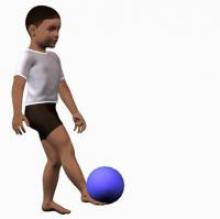
From a very early age young children show an interest in kicking a ball. This early kicking practice is important as it teaches the child to predict the path and move towards a moving ball to be in the right place for a successful kick.

Lying on the back and kicking a large ball with one or two feet lifted up off the mat is a great way to get the abdominal muscles working to stabilize the trunk. The muscle that bend the hip (hip flexors) also work to lift the leg and hold the thigh steady in the middle so that the foot can be positioned for kicking the ball. 

File download: 

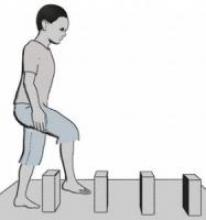
In these exercises the child practices lifting one leg to step over an obstacles. The emphasis is on keeping the knee and foot pointing forwards as the leg is lifted, as well as placing the foot down straight rather than twisted inwards. 

A good way to improve a young child's fitness is to create repeated opportunities for short bouts of all-out exercise. Jumping activities are a good way to do this in a small space, and will quickly get the heart racing and increase the breathing rate.

Below are some ideas for jumping games that can be graded to make them progressively more difficult.

PDF files : 

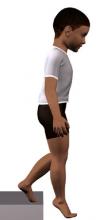
Walking and two-foot jumps on tippy toes with knees bent

Children with poor jumping abilities often have weakness in the calf muscles, particularly the soleus muscle, which makes it difficult to get a good push-of when jumping and also affects landing smoothly. 

In these activities the child practices walking and making small jumps on the tippy toes with the knees slightly bent. This action is a good way to get the soleus muscle working.